2 min to read
Project Zero Inventory: Week 1 - The Idea
Week 1 of the Project of the Month
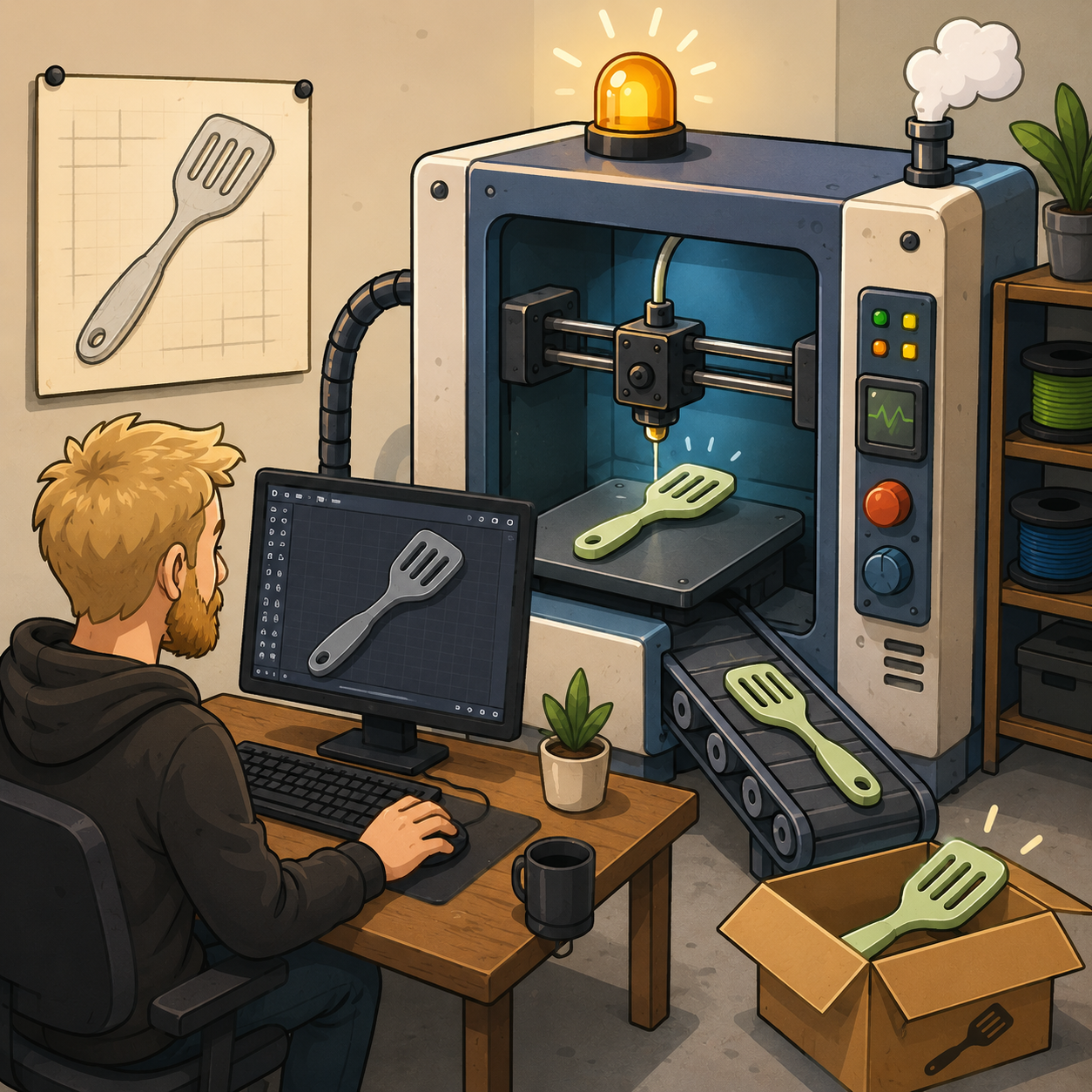
Project of the Month: Zero Inventory
Earlier this summer I added a small online store to my website. At the moment, however, it’s filled entirely with placeholder products. This month I want to change that by adding real products that people can actually purchase. After all, the mantra of this website is “From first principles to first customer and beyond!” It’s finally time to find that first customer.
The Problem
Over the past few years I’ve experimented with selling physical products online. The process is usually the same: design a product, find a manufacturer, place an order, and then try to sell it.
The problem is that manufacturers rarely want to produce just one item. Instead, they typically require minimum order quantities that can range from dozens to hundreds of units. That means I have to invest a significant amount of money into inventory before I know whether anyone actually wants the product.
And to be clear, the problem isn’t spending money. The problem is spending money before demand has been proven.
A Different Approach
I think I may have found a solution: 3D printing.
Instead of manufacturing hundreds of products up front, I can manufacture each item only after it has been ordered. In other words, the minimum order quantity becomes zero. I don’t need to maintain an inventory, and I don’t have to tie up money in products that may never sell.
Conveniently, my friend Josh recently offered to let me use his 3D printer while I experiment with this idea. That gives me an opportunity to test the business model before investing in my own printer or committing to larger-scale manufacturing.
Of course, 3D printing isn’t a perfect manufacturing solution. Compared to traditional manufacturing, each part is significantly more expensive to produce and takes much longer to make. For kitchen tools there are additional concerns as well. I’ll be using a food-safe, dishwasher-safe filament, but the layer lines inherent to 3D printing can create tiny grooves that may make some products more difficult to clean.
I don’t expect a 3D printed product to be the final product. Instead, I see it as a stepping stone. If nobody buys the product, I lose almost nothing because I never purchased inventory. If customers do start buying it, then I’ll have evidence that the idea has potential, and I can justify investing in higher-quality manufacturing methods.
Rather than manufacturing inventory first and hoping customers appear later, I want to prove the demand first and scale the manufacturing second.
The Goal
My hypothesis is that 3D printing can serve as a bridge between an idea and a manufactured product.
Over the next few weeks I’ll design a handful of kitchen tools, list them for sale on my website, and see what happens. For each product I’ll do some math and set a threshold for how many orders a product needs before I consider moving it to traditional manufacturing.
I’m excited to see whether this approach can reduce the risk of launching physical products while still allowing me to build something that people genuinely find useful. Stay tuned for updates!





Comments